The European Pallet Association just published its EU Declaration of Conformity for EPAL Euro pallets. The document is dated June 10, 2026. Here is why it matters for every U.S. manufacturer shipping goods to Europe.
Summary
EPAL has issued an EU Declaration of Conformity (June 10, 2026) for EPAL Euro pallets under PPWR Article 39, confirming compliance with Articles 5–12 and recognizing the EPAL pool as a qualifying reuse system under Articles 26–27. From August 12, 2026, every pallet on the EU market must have such documentation; EPAL will publish the declaration online and provide a QR code for shipment paperwork. This gives U.S. exporters a practical compliance path with EPAL pallets, while stringer pallets lack a declaration, do not qualify for reuse targets, and pose compliance and cost risks. EU buyers are already incorporating EPAL requirements into supplier contracts ahead of the deadline.
This development affects PPWR transport packaging obligations and supports EPAL Euro pallet export programs for U.S. shippers.
Key Background
If you’re new to the PPWR, we recommend first reading our guide, PPWR First Warehouse Rule: What U.S. Exporters Must Know in 2026, which explains where the pallet exemption ends and how the regulation affects exporters once goods enter the EU supply chain. On June 10, 2026, the European Pallet Association (EPAL) published its formal EU Declaration of Conformity for EPAL Euro pallets under Article 39 of the PPWR. The declaration was signed by EPAL CEO Bernd Dörre in Düsseldorf, Germany
This is not a government or regulatory document. EPAL is the industry association that governs the open pallet pool. The declaration is EPAL’s own formal statement that EPAL Euro pallets satisfy PPWR requirements. It is still the most useful compliance document a U.S. exporter can have in hand right now.
Here is why. If you are evaluating your EU export pallet program ahead of August 2026, this declaration is the most important compliance document currently available.
PPWR Requirements for Every Pallet
The PPWR went into force on February 11, 2025. The PPWR requirements themselves have not changed. What has changed is that EPAL has now published the supporting documentation exporters can use to demonstrate compliance. This announcement fills an important documentation gap as the August 12, 2026 deadline approaches.
Documentation Obligation
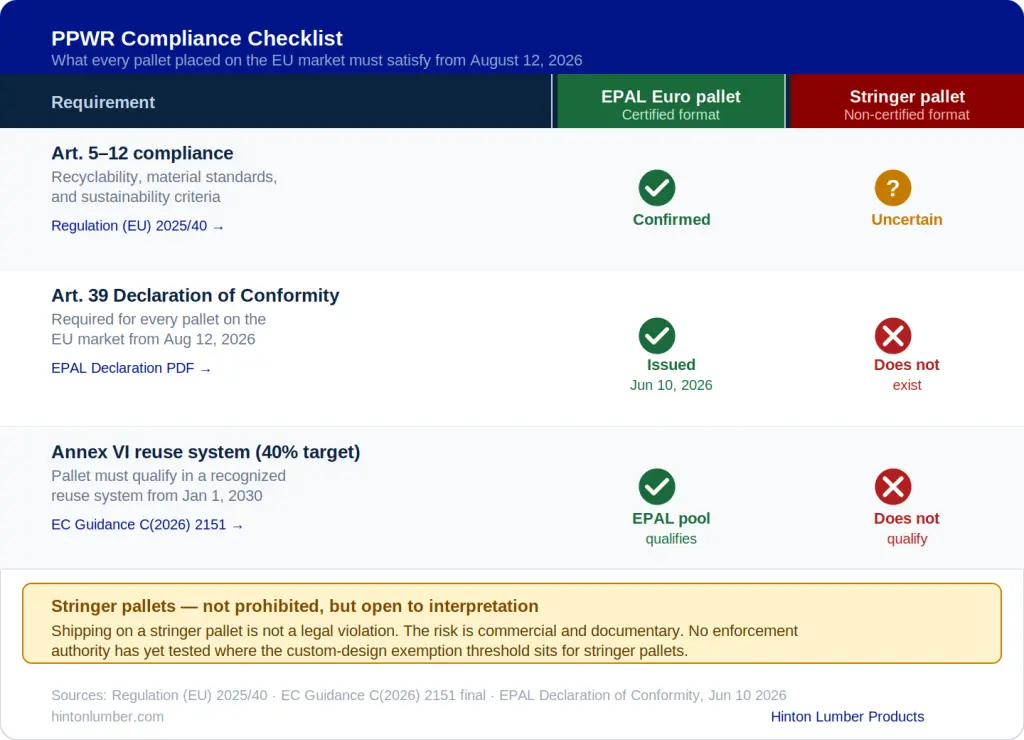
Every pallet placed on the EU market must have an EU Declaration of Conformity available. That document proves the pallet meets Articles 5 through 12. Without it, the pallet does not meet PPWR documentation requirements for the EU market.
EPAL states this plainly in its June 10 document:
“For pallets and other packaging, an EU declaration of conformity in accordance with Art. 39 PPWR must be available, which proves compliance with the regulations in Art. 5-12 PPWR.”
Most U.S. stringer pallet manufacturers do not have this document. It does not exist for their products. That is a compliance gap that begins August 12, 2026.
What the EPAL Declaration Confirms
EPAL conducted a formal conformity assessment under Article 38 PPWR and Annex VII of the regulation. The results are documented in the EU Declaration of Conformity dated June 10, 2026
The declaration confirms two things:
- EPAL Euro pallets comply with Articles 5 through 12 of the PPWR. That covers the sustainability, recyclability, and material requirements that apply from August 12, 2026.
- The declaration also confirms something specific to the reuse question. EPAL states:
“The EU declaration of conformity pursuant to Art. 39 PPWR for EPAL Euro pallets also serves as confirmation pursuant to Art. 26, 27 PPWR that EPAL Euro pallets are reusable packaging for which the EPAL pallet pool is a reuse system that meets the requirements set out in Annex VI Part A of the PPWR.”
Why the Reuse Confirmation Matters
The EPAL pool is confirmed as a qualifying reuse system under the regulation. That means EPAL pallets count toward a customer’s 40% reuse target. No additional documentation is needed to prove it. In practice, this recognizes EPAL’s open pool as an EU pallet reuse system under the PPWR
We covered the 40% reuse target and what it means for your EU customer’s compliance score in our earlier post: Do Your Pallets Pass the Test? The Hidden Costs of Non-Compliance with EU’s PPWR.
QR Code and Online Access
EPAL has committed to publishing its EU Declarations of Conformity on its website at www.epal.eu by August 12, 2026. It will also provide a QR code that can be included in delivery documents
Suppliers of EPAL pallets can include that QR code in their shipping paperwork. EU customers can scan it to access the declaration instantly. No separate document needs to change hands.
That is a practical tool for U.S. exporters. It means your EU customer can document their compliance at the point of receipt. The pallet itself carries its proof of conformity.
Why This Does Not Help a Stringer Pallet
The EPAL declaration only applies to EPAL Euro pallets. It does not apply to stringer pallets or any other non-certified format
A stringer pallet does not have a Declaration of Conformity. It is not part of a recognized reuse system. It cannot qualify toward a customer’s reuse percentage. It has no QR code. It has no documentation a customer can use to defend their compliance position. That is the crux of stringer pallet EU compliance risk
This is not a paperwork problem. It is a structural one. The PPWR was designed around reusable systems. Stringer pallets are single-use by design. They were never going to qualify.
The Commission’s March 30 guidance makes this even more specific. Once a stringer pallet clears customs and arrives at the first EU warehouse, reuse rules apply to the next leg of its journey. It cannot meet those rules. The EU customer then has two choices. They can repalletize at their own cost or absorb the compliance shortfall into their percentage calculation.
Neither option is free.
What This Means for U.S. Exporters Right Now
August 12, 2026 is weeks away. That is the date when PPWR compliance obligations begin.
Three things are now clear:
- EPAL Euro pallets have a Declaration of Conformity. They qualify as reusable packaging. They meet the requirements that apply from August 12, 2026.
- Stringer pallets have none of those things. The gap between them is no longer a matter of interpretation. It is documented.
- EU customers are already acting on this. Many are building EPAL pallet requirements into supplier contracts. Some have already done so. The closer we get to August, the less flexibility there will be for suppliers who have not yet made the switch. U.S. exporters who have not yet transitioned their EU export pallets to an EPAL-certified format now have a clear and documented reason to do so before August 12, 2026.
Hinton Lumber Products: EPAL Certified and Ready
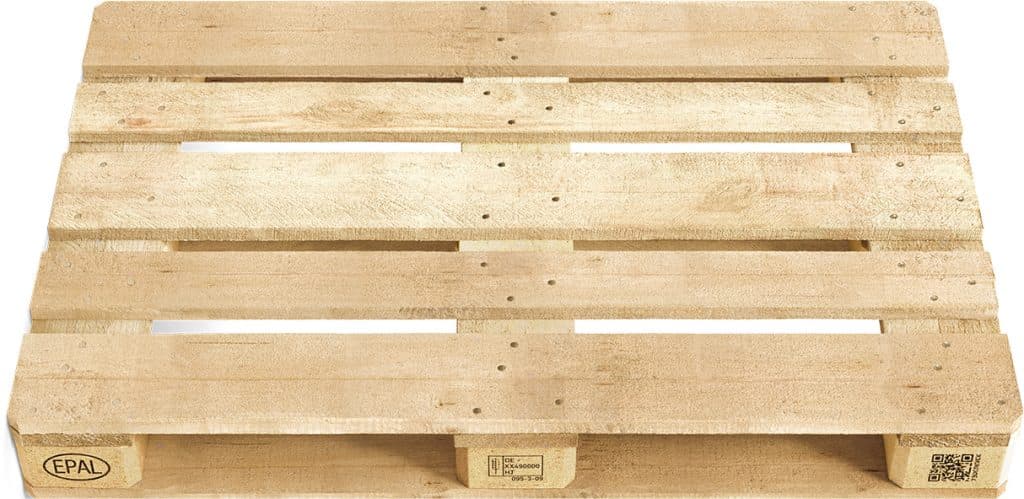
Hinton Lumber Products is one of only two U.S. manufacturers certified to produce authentic EPAL Euro pallets. We manufacture EPAL 1, EPAL 3, and CP pallets at facilities in Texas, Alabama, and South Carolina.
We can supply your EU-bound shipments with EPAL-certified pallets built to the same standards as any pallet manufactured in Europe. Our pallets ship with the documentation your EU customer needs. They enter the EPAL open pool the same way any other EPAL pallet does.
We also manufacture stringer pallets. We produce both formats. We have no incentive to steer you toward one over the other. What we can tell you is that one of them has a Declaration of Conformity and one does not. That distinction matters starting August 12, 2026.
Explore Hinton’s EPAL and Certified Pallet Options
- CP Pallets for Chemical and Pharmaceutical Exporters
Not sure where your EU export pallet program stands? Our team can help you assess your exposure and map a transition timeline before August 12, 2026.
Contact Hinton Lumber Products to discuss your EPAL pallet needs.
Frequently Asked Questions
What exactly did EPAL publish, and why does it matter?
Short answer: EPAL published an EU Declaration of Conformity for EPAL Euro pallets dated June 10, 2026, under PPWR Article 39. While not a government document, it is EPAL’s formal confirmation that EPAL Euro pallets meet PPWR requirements. It provides U.S. exporters with a concrete, recognized compliance path for transport packaging in the EU, at a time when most non-EPAL pallets (like common U.S. stringer pallets) lack any equivalent documentation.
What does the PPWR require for pallets starting August 12, 2026?
Short answer: From August 12, 2026, all pallets placed on the EU market must:
- Comply with Articles 5–12 (covering recyclability, material standards, and sustainability performance), and
- Have an EU Declaration of Conformity available to prove that compliance.
EPAL’s June 10 declaration explicitly acknowledges this requirement. Most U.S. stringer pallets do not have such a declaration, creating a clear compliance gap on that date.
Does the EPAL declaration address the EU reuse targets, and how?
Short answer: Yes. EPAL’s declaration confirms that EPAL Euro pallets are reusable packaging and that the EPAL pallet pool is a qualifying reuse system under PPWR Articles 26–27 and Annex VI Part A. This means EPAL pallets count toward customers’ 40% reuse target without additional documentation—recognizing the EPAL open pool as an EU-compliant reuse system for transport packaging.
How will EPAL’s QR code and online publication work in practice?
Short answer: By August 12, 2026, EPAL will publish its Declarations of Conformity at www.epal.eu and provide a QR code for use on delivery documents. Suppliers can include this QR code in shipment paperwork so EU customers can scan it at receipt to access the declaration instantly. This streamlines documentation and lets the pallet effectively “carry” its proof of conformity.
I use stringer pallets, what’s the compliance risk and what should I do now?
Short answer: Stringer pallets lack an EU Declaration of Conformity, are not part of a recognized reuse system, and therefore do not count toward reuse targets. Per the Commission’s March 30 guidance, once a stringer pallet reaches the first EU warehouse, reuse rules apply to the next leg—and stringers cannot meet them. EU customers must then either repalletize (added cost and delay) or absorb a compliance shortfall. With many EU buyers already adding EPAL requirements to contracts ahead of August 12, 2026, U.S. exporters should transition to EPAL Euro pallets now. Hinton Lumber is EPAL-certified (EPAL 1, EPAL 3, and CP pallets) and can supply EU-bound shipments with the documentation and pool compatibility your customers need.
I ship on certified HT pallets. Is that enough to ship into the EU?
Short Answer: Yes, for crossing the border. ISPM-15 heat-treated pallets satisfies EU phytosanitary requirements at the port of entry. Your pallets will clear customs.
But HT and PPWR are two separate requirements. ISPM-15 HT pallets address biosecurity. PPWR addresses reuse and sustainability. They do not overlap. HT pallets get your products into the EU. EPAL pallets are what keep it moving through the EU supply chain.
HT gets your pallet into the EU. EPAL is what keeps it moving through the EU supply chain
What is an EU export pallet program and do I need one?
Short Answer: It is a defined approach to which pallet format you use for EU-bound shipments, covering specification, documentation, and pool compatibility
Before PPWR, most U.S. exporters used whatever pallet was available. After August 12, 2026, that creates compliance exposure for your EU customer. Switching to EPAL pallets and ensuring your supplier provides the Article 39 Declaration of Conformity is the practical solution.
Hinton Lumber can help you build that program. We supply EPAL 1, EPAL 3, and CP pallets from U.S. facilities and ship with full documentation for your EU customers.