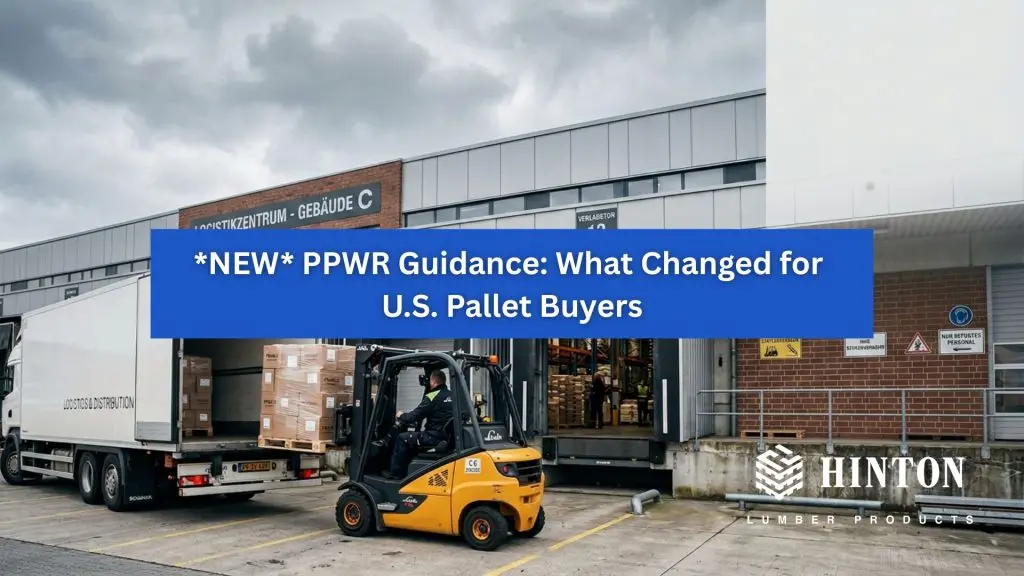
The EU Commission published an updated FAQ on the Packaging and Packaging Waste Regulation (PPWR) on August 1, 2026. It landed just days before the August 12 application date. Most of it is technical. Two parts matter directly for anyone buying or building stringer pallets, EPAL pallets, CP pallets, or export pallets for EU-bound freight, and one of them changes who is on the hook for compliance.
The EU’s New PPWR FAQ, Summarized
The Commission’s updated FAQ runs long. Most of it will not affect a pallet buyer’s day-to-day decisions. A few parts do. We want to walk through them plainly.
The full document is available directly from the European Commission here: PPWR Frequently Asked Questions, 2nd edition.
Three Key Changes in the New PPWR FAQ
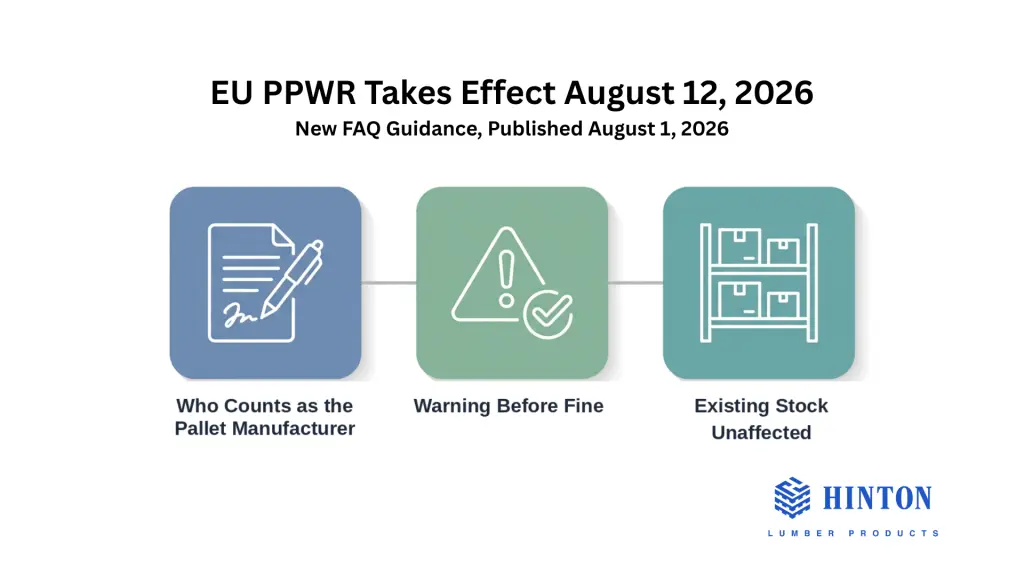
Who counts as the “manufacturer.” The Commission clarified this directly. Say a company commissions packaging to its own proprietary spec. No branding. No trademark from the pallet builder. The company that defined the spec and signed off on it is the manufacturer under PPWR. Not the pallet supplier.
This matters more than it sounds like it does. Nearly every customized pallet in this industry, whether it’s a 48×40 pallet, custom pallet, a stringer pallet, or an export pallet, is built to a customer-provided spec. Stringer or block, it does not matter. That means the compliance obligation, the Declaration of Conformity, the technical documentation, and the substance evidence, sits with the customer. Not with the pallet manufacturer building to order.
This is the clarification worth reading twice. Say your company hands a pallet manufacturer your own drawing, tolerances, or spec sheet. Say you sign off on it. PPWR treats your company as the manufacturer of that packaging. Not the shop that cut and assembled it. Being the manufacturer under PPWR is not a label without consequence. It is the party that must hold the Declaration of Conformity and technical file. It is the party a member state authority will look to first if something does not check out. Article 68 penalties for non-compliant packaging attach to the manufacturer. A specified, signed-off custom pallet design can make your company that manufacturer. The fine exposure comes with it, regardless of who physically built the pallet.
We are not the ones who decide this. The Commission is. But it is worth being direct about what it means. If you are shipping into the EU on a custom stringer pallet, the compliance file is yours to hold. So is the risk if it is missing.
How enforcement will actually work. The new FAQ also lays out what happens if packaging is found non-compliant after August 12. Companies get a warning first, and a chance to correct the problem, before a member state moves to fines, recalls, or withdrawal. The Commission is explicit that enforcement should not disrupt trade flows or supply chains. This does not remove the underlying compliance obligation. It does mean the day-one risk is a warning, not an immediate shutdown.
Existing stock is not affected. Pallets and packaging already produced, but not yet placed on the EU market by August 12, do not need to be destroyed, rebuilt, or relabeled. This gives some breathing room for inventory already in the pipeline.
Recyclable vs. Reusable: Two Different Compliance Questions
We keep seeing these two questions collapsed into one. They are not the same thing.
Recyclability. Every wood pallet clears this bar. Wood can be ground down and recycled at end of life. Stringer, block, EPAL, all of it. This part is not in dispute. It is not where the real risk sits.
Reusability. This is where stringer pallets run into trouble. A pallet only counts as “reusable” under PPWR if there is a documented, evidence-backed system for it to go through another use cycle in the EU. That means a real resale or return market that is tracked and provable.
A non-standard pallet with no established EU resale market does not become “reusable” just because someone argues it theoretically could be reused. PPWR requires evidence of the next cycle. Not a hypothetical one. This is exactly why pooled systems like EPAL pallets and CP pallets clear the reuse bar and a one-off stringer pallet does not. It is not the wood. It is the documented path back into circulation.
The Real Risk: Compliance Percentage, Fines, and Slower Passage
A stringer pallet with a valid Declaration of Conformity can still move through EU customs. It is not held at the border for lacking a reuse credential.
But it does not count toward the receiving company’s 2030 reuse percentage. That gap compounds. A company relying heavily on non-reusable pallets across its EU transport packaging risks falling short of the 40% target. Shortfalls carry Article 68 penalty exposure for whoever owns the compliance obligation. They can also mean audits, requests for documentation a stringer pallet cannot supply, and pressure from EU customers who want a cleaner compliance file of their own.
None of that shows up as a border stop. All of it shows up as cost, friction, and risk further down the line, exactly where it is harder to fix.
Stringer Pallets Are Okay at Customs, Okay at the First Warehouse, But Not Automatically Beyond That
The Commission’s March 2026 guidance confirms the core mechanic: reuse obligations apply from the moment goods are placed on the EU market, and that typically happens at the first EU warehouse.
What determines whether the exemption extends past that point is narrower and more specific than most guidance circulating right now suggests. Per the Commission’s own language, the reuse rules apply “from the first warehouse located within the Union until the final destination,” unless the shipment goes to a single final destination and is never split up or redistributed. A cross-dock or logistics hub along the way doesn’t break that on its own, the guidance is explicit that distribution centers and hubs don’t count as a “final destination.”
This is a fact-specific rule with real edge cases, and it deserves its own detailed breakdown rather than a few paragraphs here. We’ll cover the full mechanics, what counts as a single destination, and how multi-leg shipments are treated, in a dedicated post soon.
For now, the takeaway for U.S. exporters is simple: don’t assume a stringer pallet’s exemption automatically covers a shipment all the way to its final EU destination. Whether it does depends on specifics worth checking before you rely on it.
Hinton Lumber Products’ Position
The new guidance clarifies who is responsible for compliance. It does not settle every open question, including exactly how far a stringer pallet’s practical cover extends toward a shipment’s final EU destination. That is a question Hinton Lumber Products has taken a clear position on, and we are saying so directly.
“Let me be crystal clear. A stringer pallet manufactured in the U.S. and shipped under load is NOT exempt from PPWR’s reuse requirements after the first receiving warehouse in Europe,” said Hinton Howell, COO, Hinton Lumber Products. Howell is an active leader in domestic and global pallet industry interests and has closely followed this regulation for over three years.
Hinton Lumber Products manufactures EPAL-certified pallets, CP pallets, custom pallets, export pallets, and stringer pallets. We do not have a stake in which format you choose. We do have a stake in you choosing with accurate information.
Which Pallet Format Fits Your EU Shipment
If you’re weighing formats for EU-bound freight, here’s where each option stands under PPWR:
- EPAL pallets and EPAL CP Pallets carry a published Declaration of Conformity and count toward the 2030 reuse target through the open EPAL pool.
- Chemical pallets (CP) serve the same reuse-system advantage for chemical and industrial shipments with sector-specific handling needs.
- Custom pallets built to your own proprietary spec make your company the manufacturer of record under PPWR, with the compliance file to match.
- Export pallets built to ISPM-15 heat-treatment standards handle customs clearance, but heat treatment alone doesn’t establish reuse-system eligibility.
- Stringer pallets remain a sound, lower-cost option for single-destination shipments and non-EU legs of your supply chain. Companies operating closed-loop distribution networks may also benefit from Pallet Repair & Reuse Programs that extend pallet life and reduce overall costs.
Talk to Hinton About Your EU Pallet Program
Not sure where your current pallet program stands under PPWR? Our team can walk through your EU shipping lanes, pallet specifications, and Transport & Logistics Solutions to help ensure your shipments arrive on time while supporting your compliance goals.
Talk to our export compliance team
Hinton Lumber Products is not a legal or regulatory authority. This article reflects our reading of publicly available EU Commission guidance as of publication and should not be treated as legal advice. Please consult a qualified customs or regulatory attorney for guidance specific to your supply chain.
Frequently Asked Questions About PPWR and Stringer Pallets
Can a stringer pallet still move through EU customs after August 12?
Yes, if it carries a valid Declaration of Conformity. The real exposure is reuse percentage and documentation, not border entry. A non-conforming pallet does not count toward a company’s PPWR reuse target, and missing documentation can trigger fines under Article 68.
Who is the “manufacturer” of a pallet under PPWR?
The manufacturer is whoever specifies the pallet’s design, not necessarily whoever physically builds it. If a customer provides its own proprietary spec and signs off on it, PPWR treats that customer as the manufacturer, and the compliance responsibility follows.
What happens if a pallet isn’t compliant after August 12?
The Commission’s FAQ update, published August 1, 2026, says companies get a warning and a chance to correct the issue first. Fines, recalls, or withdrawal only follow if the problem isn’t fixed.
Does existing pallet stock need to be replaced before August 12?
No. Pallets already produced but not yet placed on the EU market do not need to be destroyed, rebuilt, or relabeled.
Are all wood pallets recyclable under PPWR?
Yes. Wood can be ground and recycled at end of life, regardless of pallet format.
Are all wood pallets reusable under PPWR?
No. A pallet only counts as reusable if there is a documented, evidence-backed resale or return market for it in the EU. A non-standard pallet with no such market does not qualify, even if reuse is theoretically possible.
Does a stringer pallet’s exemption last all the way to final delivery?
Not automatically. It depends on the shipment. The Commission’s guidance ties it to whether the goods go to a single final destination or get split up and redistributed along the way. We’re covering the details in a follow-up post.
When does PPWR apply?
The general application date is August 12, 2026. Most core requirements begin then. Reuse targets phase in through 2030.
Most Popular PPWR Articles
PPWR Transport Packaging: EPAL EU Declaration of Conformity
The European Pallet Association just published its EU Declaration of
PPWR First Warehouse Rule: What U.S. Exporters Must Know in 2026
This report does not constitute legal advice or official regulatory

Do Your Pallets Pass the Test? The Hidden Costs of Non-Compliance with EU’s PPWR
Exporting to Europe? Then ISPM-15 isn’t enough anymore. The European Union’s new Packaging and Packaging Waste Regulation (PPWR) isn’t just changing packaging requirements, it’s creating a competitive divide between U.S. exporters who adapt and those who don’t.