
A follow-up to our March 2026 market update, “Pallet Lumber Prices Are Surging in 2026.” That article explained the mill-side supply issues. This update explains why freight has become the larger driver of delivered pallet costs.
SUMMARY
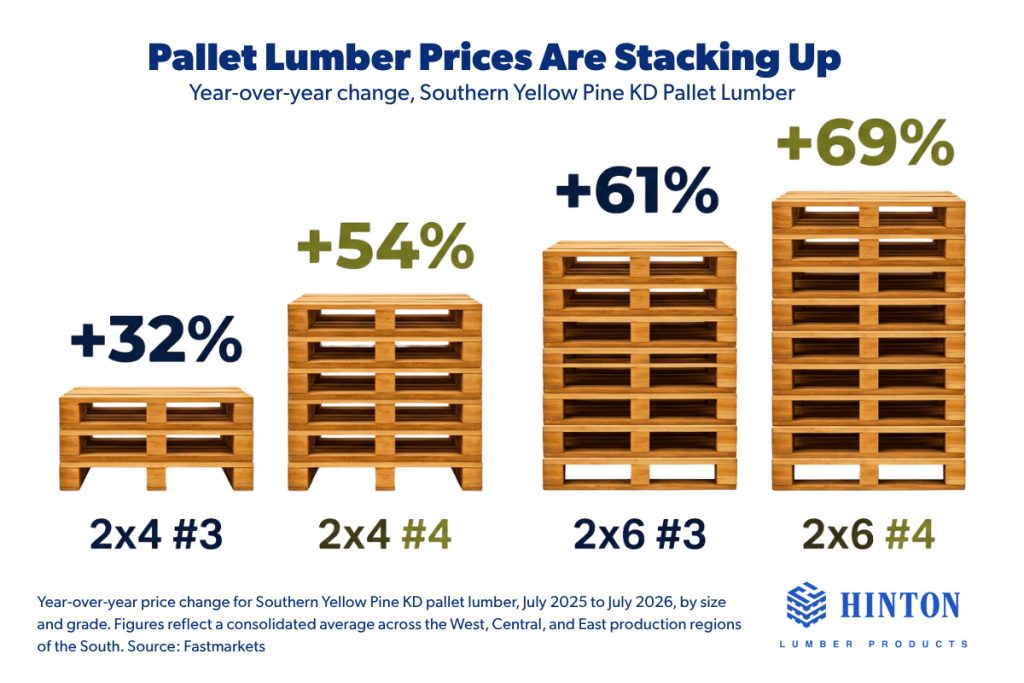
Freight costs, not mill supply, are now the bigger driver of delivered pallet costs. Pallet lumber prices remain 20% to 78% higher year over year, but transportation costs are having a greater impact on what customers ultimately pay.
Pallet lumber prices have been rising for two reasons happening at once. Mills have been producing less low-grade lumber, and rising fuel costs from the Iran conflict have been pushing up lumber freight costs. That combination is still in play.
Although prices have eased from their April peak, most #3 and #4 grades remain well above last year’s levels. This article explains why freight has overtaken mill supply as the primary driver of delivered pallet costs and what that means for pallet buyers.
What has changed is where the cost pressure is coming from. Mill supply has steadied some since spring. Freight has not. Pallet lumber makes three separate truck trips before it reaches a customer: log to mill, mill to plant, and plant to dock. Freight costs stack at every step, and that compounding effect is now doing more to drive delivered pricing than the mill-side shortage that started this cycle. That compounding is also a major reason for the pallet lumber cost increase customers have felt throughout 2026. Two new developments this year, a Supreme Court ruling on broker liability and stricter enforcement of driver English requirements, are making trucks harder and more expensive to book. As a result, freight, not mill pricing, is now the primary driver of delivered pallet costs.
This update walks through what changed in plain terms and shows pricing trends by grade for the southern region, including how these freight pressures affect the cost and availability of wooden pallets throughout North American supply chains.
WHAT’S NEW
- Lumber prices peaked in April 2026 and have eased 10% to 15% since, but remain well above last year’s levels.
- A May 2026 Supreme Court ruling now lets injured people sue freight brokers directly, and brokers are responding by raising insurance requirements and dropping riskier carriers.
- Stricter federal rules requiring truck drivers to speak English have pulled thousands of drivers off the road, on top of an existing driver shortage. –
- Together, these freight-side changes are now a bigger factor in delivered lumber cost than the mill supply shortage, keeping lumber freight costs elevated.
WHY TRUCKING GOT MORE EXPENSIVE
In short: three separate trucking problems hit within a few months of each other in 2026. Any one of them would have pushed freight costs up. All three together made trucks harder to find and more expensive to book, especially for lower-value freight like pallets and pallet lumber, as well as wooden pallets bound for distribution centers.
- Iran conflict and oil prices What happened: War in the Middle East shut down a key oil shipping route starting in late February 2026. Oil prices spiked, and so did diesel. U.S. diesel prices rose as much as 40% to 58% before easing some after a ceasefire in June. What it means for lumber freight: Diesel is a trucking company’s biggest cost besides the driver. When diesel goes up, carriers add fuel surcharges, and those get passed straight through to lumber and pallet buyers, including pallet manufacturer operations.
- Supreme Court ruling on freight brokers What happened: On May 14, 2026, the Supreme Court ruled that freight brokers, like C.H. Robinson, can be sued when they hire an unsafe trucking company. Brokers used to be shielded from these lawsuits. Now they are not. What it means for lumber freight: Brokers are raising the insurance they require from carriers and cutting ties with lower-rated ones. Smaller trucking companies that can’t afford the new insurance costs are losing access to freight, which shrinks the pool of trucks available to move lumber and pallet lumber.
- English-language rules for drivers What happened: Federal inspectors are now pulling drivers off the road if they can’t demonstrate English proficiency during a roadside stop. Enforcement has ramped up steadily since mid-2025, and new limits on driver licensing have added to it. What it means for lumber freight: Every driver taken out of service is one less truck moving freight. This comes on top of a trucking industry that already didn’t have enough drivers, roughly 80,000 short nationwide, with the tightest impact in the Southeast and Texas, right where Hinton’s mills and much of the pallet lumber supply chain sit, including many southern yellow pine markets.
These pressures aren’t going away overnight, but customers don’t have to navigate them alone. Hinton Lumber’s team works directly with each account to build a sourcing plan that fits real volume needs, whether that means locking in contract pricing, exploring alternative specifications, or adjusting order timing to avoid the worst of the spot market swings.
Reach out to a Hinton account representative to talk through what these freight and pricing shifts mean for your specific program and learn how our Transport & Logistics services help reduce shipping delays, improve delivery reliability, and better manage transportation costs.
YOUR QUESTIONS, ANSWERED
How does transportation impact lumber prices?
Transportation has become a larger contributor to delivered pallet costs because lumber typically moves through three separate trucking stages before a finished pallet reaches the customer. Each trip adds freight expense, and those costs compound throughout the supply chain.
- Logs to the mill. Trucking is usually a logger’s highest cost even in normal years, and it hits pallet-grade wood hardest, since low-value wood costs more to haul relative to what it’s worth.
- Mill to pallet manufacturer. A standard truckload move competing for the same shrinking pool of trucks as everything else.
- Pallets to the customer’s dock. Same tight capacity, same higher rates, one more time, now affecting wooden pallets in addition to other products.
When capacity is tight, carriers can get a better rate on the spot market than on a standing contract, so some reroute trucks to chase that higher-paying freight instead of honoring existing commitments. That’s part of why freight costs have climbed across the industry as capacity has tightened, and why the increase shows up in delivered cost, not just in published mill prices.
That same freight pressure is also why prices rose so sharply into April, then eased some. Mill supply problems and the first wave of freight cost increases hit at once in early 2026, pushing prices to their highest point that month. A ceasefire eased oil prices some in June, taking off part of that pressure. But the Supreme Court ruling on broker liability and the driver English enforcement rules aren’t tied to the war. Those keep freight costs higher even as fuel costs ease and continue to influence pallet lumber prices 2026.
Why doesn’t a price index show the real delivered cost?
Published lumber prices only tell part of the story. Indices like Fastmarkets report pricing on an FOB mill basis. They don’t capture the cost of the final leg, getting lumber from the mill to a manufacturing plant and on to the customer, and that gap has widened as lumber freight costs have risen. The cost of shipping finished pallets from the plant to the customer’s dock is baked into the pallet price the same way, and it doesn’t show up on any published index either. That’s part of why delivered cost can look very different from the mill price a customer might see quoted elsewhere.
Is this a totally new problem?
Not entirely. Mills still make less #4 grade lumber than they used to, and when #4 runs short, buyers shift to #3, which pushes #3 prices up too. What’s new is that freight has become the bigger driver of delivered cost, and a key contributor to the pallet lumber cost increase customers have seen in 2026.
What is Hinton doing about it?
Hinton Lumber Products is working with more carriers and brokers to avoid relying on just a few, and is prioritizing partners who meet the new insurance and safety standards. Where possible, Hinton is also using its own trucks on backhauls to help offset rising freight costs, and is growing its dedicated fleet to handle these challenges directly. Pricing stays tied to actual freight and lumber costs rather than blanket increases, with close coordination between our mills and pallet manufacturer partners.