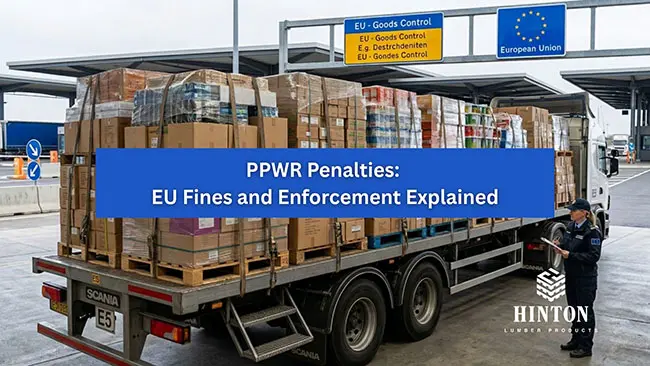
PPWR fines of €250,000, €500,000 and even potential prison terms in Ireland are among the concerns raised by compliance consultants for EU exporters. But what does EU law actually say about penalties and enforcement?
Here is the thing: most of those numbers do not appear anywhere in the regulation itself.
Regulation (EU) 2025/40 sets no fine amounts. It requires each of the 27 EU member states to establish its own penalty system by February 12, 2027. The exposure you face depends on which countries your pallets end up in and whether those countries have published their frameworks yet.
For pallet manufacturers and companies that ship on pallets to the EU, the picture is more nuanced than trade press and compliance consultants’ marketing material suggests. For a broader overview of packaging requirements, see our guide to PPWR compliance for U.S. exporters.
Here is a practical look at how PPWR penalties and fines actually work.
Does PPWR Set Specific Fine Amounts for Non-Compliance?
No. Article 68 of the regulation requires member states to establish penalties that are effective, proportionate, and dissuasive. The regulation itself does not specify fine amounts. Instead, PPWR Article 68 penalties are determined under national law, not EU law. As of late 2026, most member states have not yet published PPWR-specific penalty frameworks.
Germany is the notable exception. The Packaging Law Implementation Act (VerpackDG), which came into force August 12, 2026, provides for fines of up to €200,000 (~$224,000) per breach. That is a confirmed, legislated number. Most of the other big figures circulating in the market come from compliance vendor marketing material, not from enacted law.
What is the Fine Risk and When Do PPWR Pallet Penalties Take Effect?
Two separate windows apply, and they are not the same.
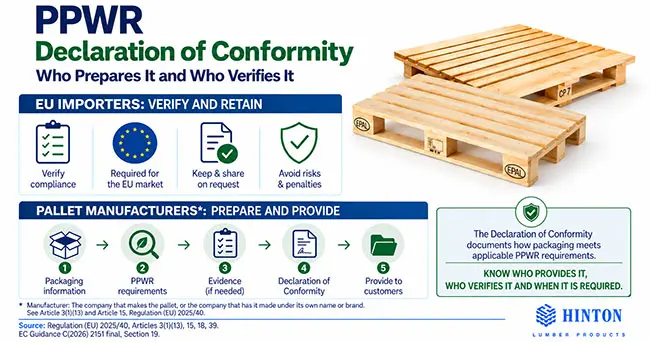
The first window is now. From August 12, 2026, every pallet placed on the EU market must have a Declaration of Conformity (DoC) under Article 39 of the PPWR. This document proves the pallet meets the sustainability requirements in Articles 5 through 12 including substance restrictions, recyclability by design, and labelling. A pallet that cannot produce this document when an authority asks for it faces enforcement action regardless of where fine amounts currently stand.
The second window is 2030. That is when the Article 29(1) reuse target kicks in. From January 1, 2030, at least 40% of transport packaging used within the EU must be in a qualifying reuse system. A stringer pallet has no qualifying EU reuse system. It cannot count toward that 40% target.
These two obligations are distinct. The DoC gap is active today. The reuse gap becomes a violation in 2030.
Which Pallets Have a Declaration of Conformity Right Now?
EPAL Euro pallets do. The European Pallet Association issued its EU Declaration of Conformity under Article 39 PPWR on June 10, 2026. It confirms that EPAL Euro pallets meet Articles 5 through 12 and that the EPAL open pool qualifies as a reuse system under Annex VI Part A of the regulation. Users of EPAL pallets can request this document from their supplier or access it directly through EPAL. Companies evaluating compliant pallet options can review Hinton’s EPAL Euro pallets.
The June 10, 2026 Declaration of Conformity reflects requirements as they stand today. Implementing acts under Article 12 are expected to be finalized in 2027 or 2028. EPAL will update its declaration to confirm compliance with the standardized reusable packaging label format. Shippers using EPAL pallets should expect that update and stay in contact with their supplier.
Standard U.S. stringer pallets do not have a Declaration of Conformity. A stringer pallet manufacturer could theoretically self-declare one covering the sustainability requirements in Articles 5 through 12. A wood stringer pallet likely meets recyclability-by-design and substance restrictions. But that DoC cannot assert compliance with Articles 26 and 27, the reuse system requirements, because no qualifying EU reuse system exists for stringer pallets. The doable part addresses today’s requirements. The problem arises in 2030.
Who Is Responsible for the Pallet DoC: The Pallet Manufacturer or the Shipper?
It depends on the pallet. The Commission published an updated FAQ on August 3, 2026, available at environment.ec.europa.eu/publications/faq-packaging-and-packaging-waste-regulation-ppwr_en, which establishes a three-tier framework for identifying the manufacturer of transport packaging.
Tier 1: Unbranded transport packaging. The company that physically manufactures the pallet is the manufacturer and owns the DoC obligation. For most standard stringer pallets made to no particular customer specification, the pallet supplier is the manufacturer.
Tier 2: Branded transport packaging. If the pallet carries a company name or trademark belonging to the user rather than the maker, that company is the manufacturer. The DoC obligation shifts to them.
Tier 3: Dual trademark. Where both a company name and a separate trademark appear on the pallet, the FAQ requires a case-by-case assessment based on contractual agreement between the parties. This is the least settled scenario and the one most likely to generate a dispute about who carries the DoC burden.
The earlier C(2026) 2151 guidance adds one more factor: the regulation also defines the manufacturer as the party who “orders and decides the design.” A customer who specifies a pallet design to their supplier may take on the manufacturer role even without brand markings. The DoC obligation follows the design decision.
The practical takeaway for pallet buyers:
- If you buy a standard unbranded stringer pallet and specify nothing, your supplier owns the DoC problem.
- If you put your name on a pallet or specify its design, you own the DoC problem.
- If both names appear on it, you need a contract that settles who owns it.
- In all three cases, a stringer pallet DoC can only cover today’s sustainability requirements. It cannot assert reuse system compliance until a qualifying EU reuse system exists for stringer pallets. That gap does not go away regardless of who signs the document.
EPAL sidesteps this entire question. The EPAL Declaration of Conformity was issued June 10, 2026. It is available to any user of EPAL pallets through their supplier. No internal debate about who owns the DoC. No contractual negotiation required.
Who Is Responsible for the 40% Reuse Target?
That obligation falls on the EU importer or distributor, whoever places the product on the EU market. The Commission’s guidance defines this as the economic operator that “places a product on the Union market in a relevant transport packaging, be it as a manufacturer, importer or distributor.”
For a U.S. company shipping to an EU customer, the EU customer is the one responsible for meeting the reuse percentage. But here is the practical reality: every stringer pallet they receive drags their percentage down. They are already managing that math. Many are writing EPAL specifications into supplier contracts right now.
Can EU Authorities Block Pallet Shipments Without Issuing a Fine?
Yes. This is the part that gets missed entirely in the fine-number conversation.
Most people focus on what a fine costs. That is the wrong question. The right question is what happens before a fine is ever calculated. And the answer starts with a simple point: if you are shipping stringer pallets into the EU with no Declaration of Conformity in place, you are out of compliance right now. A market surveillance authority can act on that today. Beyond penalties, compliance failures may create shipping delays and other operational costs.
The enforcement toolkit. Market surveillance authorities across the EU operate under Regulation (EU) 2019/1020, which came into force in July 2021. The regulation establishes the EU’s market surveillance framework for products subject to EU harmonization legislation. PPWR brings transport packaging, including pallets, into that framework.
The enforcement powers that follow are the same ones authorities have applied to other product categories for years. That regulation gives authorities a toolkit unrelated to fine schedules. They can require withdrawal from the market. They can order a recall. They can prohibit marketing of specific packaging. They can hold shipments at the border pending documentation review. None of those actions require a fine.
The trigger is almost always a documentation request. Under PPWR Article 39, the Declaration of Conformity must be available to authorities upon request. Available does not mean submitted in advance. It means producible on demand. If an operator cannot produce the technical file and the DoC promptly, the authority does not wait. It acts.
Has this actually happened? Not yet for PPWR pallets specifically. The regulation has only been in application since August 12, 2026. But the playbook is established.
EU market surveillance authorities have used these exact powers for years under product compliance frameworks that require manufacturer declarations and technical documentation. The documentation request and withdrawal powers in Regulation (EU) 2019/1020 are not new. PPWR extends the same enforcement logic to packaging.
The pattern is consistent. An authority spots a product in the market that lacks documentation. It issues an information request. The operator cannot respond in time or cannot respond at all. The authority issues a restriction or a withdrawal order. In some cases, it enters the product into ICSMS before any penalty proceeding begins.
The cross-border multiplier. Once non-compliance is entered into the EU’s Information and Communication System for Market Surveillance (ICSMS), the EU market surveillance information system, it becomes visible to authorities across all member states. One documentation failure in one country can trigger parallel proceedings elsewhere. That is a materially worse outcome than a single fine.
The EU importer of record is your customer. The documentation gap your pallet creates becomes their enforcement exposure across every market they operate in. That conversation can end supplier relationships, regardless of what any fine schedule says.
What Does the Fine Exposure Look Like Country by Country?
PPWR penalties for non-compliant pallets will depend on the enforcement laws established by individual EU member states. While the regulation requires countries to introduce effective penalties, the specific fines and enforcement measures may vary depending on the country and the nature of the violation.
Here is what is confirmed as of October 2026, using current exchange rates (1 EUR = ~$1.12 USD):
Country | Max Fine | USD ~ | Status and Legal Basis |
|---|---|---|---|
Germany | €200,000 | ~$224,000 | New PPWR-specific legislation. VerpackDG passed Bundestag June 2026. In force Aug 12, 2026. PPWR-specific sanctions activate Feb 2027. |
Spain | €600,000 | ~$672,000 | Pre-existing national law, predates PPWR. Law 7/2022 + Royal Decree 1055/2022. PPWR absorbed into this framework from Aug 2026. |
Ireland | €500,000 (indictment) | ~$560,000 | Pre-existing framework, updated for PPWR. EU Packaging Regulations 2014 (S.I. 282/2014) as amended. Compliance through Repak. PPWR obligations absorbed Aug 12, 2026. |
France | €100,000 | ~$112,000 | Pre-existing framework, no new PPWR law yet. DGCCRF designated as national market surveillance authority. PPWR-specific penalty regime not yet adopted. |
Sweden | 30,000 kr failure to register | ~$3,000 | Pre-existing framework, updated for PPWR. Governed by Naturvårdsverket under ordinance (2022:1274). PPWR transport packaging-specific penalties not yet published. |
The Germany figures are the most operationally relevant for most U.S. exporters given the volume of trade flowing through German distribution. The minimum documented fine for a formal breach including a missing Declaration of Conformity is €10,000 (~$11,200) per violation. What “per violation” means in practice, per shipment, per pallet, or per product type, has not been tested in case law yet. That ambiguity is its own risk for high-volume shippers.
Has EU Pallet Enforcement Started Under PPWR?
Carefully, and with warnings first. The Commission’s FAQ v2 (August 3, 2026) is explicit: entry into application on August 12, 2026, will not immediately block non-compliant products from the EU market. Further measures such as prohibiting, recalling or withdrawing non-compliant packaging should only be taken if non-compliance persists. That does not mean enforcement is absent. It means the sequence is: documentation request, warning, opportunity to correct, then sanctions.
EU pallet enforcement also extends beyond regulatory authorities. What is already active, and faster than regulatory enforcement, is commercial enforcement. Large EU importers in chemicals, pharma, food, and manufacturing are writing PPWR compliance requirements into supplier contracts now. Marketplace platforms are blocking listings from sellers without valid EPR (Extended Producer Responsibility) registration. Neither requires a fine schedule to exist.
What Should Pallet Shippers Know About PPWR Penalties and Enforcement?
The compliance problem today is the missing Declaration of Conformity, not the 40% reuse target. The DoC requirement is live. Enforcement is cautious but not absent. Germany’s fine framework is confirmed and ranges from €10,000 to €200,000 per breach.
The simplest path through this is EPAL. The DoC exists. The reuse system is confirmed under Annex VI. The pallet qualifies toward the customer’s 2030 target. The documentation question has one answer: the EPAL Declaration issued June 10, 2026.
Shippers who want to continue with stringer pallets are not prohibited from doing so. But the documentation gap is real, the commercial pressure from EU customers is building, and the reuse obligation arrives in 2030 whether the fine schedule is ready or not.
How Can Hinton Lumber Products Help?
The compliance window is open now. If your EU customers are asking questions about pallet documentation, or building EPAL requirements into their contracts, the time to act is before the next order. Hinton Lumber Products is the largest block pallet producer in the United States and one of only two U.S. manufacturers certified to produce authentic EPAL Euro pallets. We manufacture both stringer pallets and EPAL Euro pallets to support different shipping and export requirements. We have no incentive to push you one way or the other. What we can do is help you understand exactly where your current program stands. Reach out to our team and we will walk you through it.
Sources:
- Regulation (EU) 2025/40 (PPWR): https://eur-lex.europa.eu/eli/reg/2025/40/oj/eng
- EC Guidance C(2026) 2151 final, March 30, 2026: https://environment.ec.europa.eu/publications/guidance-document-packaging-and-packaging-waste-regulation-ppwr_en
- EPAL EU Declaration of Conformity, June 10, 2026: https://www.epal-pallets.org/fileadmin/user_upload/ntg_package/Presse/EN/Supporting_material/PPWR-Conformity-declaration_EPAL-1_EN.pdf
- Germany VerpackDG: https://www.bundesrat.de/SharedDocs/drucksachen/2026/0001-0100/18-26.pdf?__blob=publicationFile&v=1
- Spain Law 7/2022: https://www.boe.es/eli/es/l/2022/04/08/7/con
- Spain Royal Decree 1055/2022: https://www.boe.es/eli/es/rd/2022/12/27/1055
- Ireland EU Packaging Regulations 2014: https://www.irishstatutebook.ie/eli/2014/si/282/made/en/print
- Naturvårdsverket PPWR guidance: https://www.naturvardsverket.se/en/guidance/extended-producer-responsibility-epr/packaging-and-packaging-waste-regulation-ppwr/
- EC PPWR FAQ v2, DG Environment, August 3, 2026: https://environment.ec.europa.eu/publications/faq-packaging-and-packaging-waste-regulation-ppwr_en
- GetReady Compliance, PPWR Penalties, August 2026: https://getreadycompliance.eu/ppwr-penalties-non-compliance/
- Regulation (EU) 2019/1020 (market surveillance): https://eur-lex.europa.eu/legal-content/EN/TXT/?uri=CELEX%3A32019R1020
Disclaimer: This content is intended for informational purposes for supply chain practitioners. It reflects Hinton Lumber Products’ interpretation of publicly available regulatory documents and does not constitute legal or compliance advice. Consult qualified legal counsel for guidance specific to your situation.
About the author — Hinton H. Howell
Hinton H. Howell is Chief Operating Officer of Hinton Lumber Products, the largest block pallet manufacturer in the United States. Hinton Lumber Products operates manufacturing facilities serving the greater Charleston, South Carolina, Houston, Texas, and Tuscaloosa, Alabama markets. Hinton Lumber is one of two manufacturers in the U.S. with EPAL certification for Euro pallet production. Howell served as Board Chair of Woodpack Global (formerly the National Wooden Pallet and Container Association, NWPCA) during the period when the EU Packaging and Packaging Waste Regulation was negotiated. He remains active in EU and global wood pallet and packaging initiatives.