
By Keith Reinstetle, National Sales Executive
As temperatures rise and humidity returns, warehouse and manufacturing environments face a familiar, but often underestimated, risk: wood pallet mold, especially for industrial pallets.
Seasonal transitions, especially spring and summer, create the perfect conditions for moisture buildup. And in palletized supply chains, moisture doesn’t just affect wood… it impacts product quality, automation performance, and operational uptime.
The good news? With the right storage practices, mold risk is highly manageable. Learn how moisture impacts pallet performance.
Why Seasonal Changes Increase Pallet Mold Risk
Mold requires just three things: moisture, oxygen, and a food source (wood). In most facilities, all three are present.
- Warm temperatures + humidity accelerate mold growth
- Mold can develop in as little as 48- 72 hours on damp wood
- Wood above ~19% moisture content significantly increases mold risk
Even heat-treated pallets are not immune, because heat treatment does not remove all moisture.
Bottom line: Moisture, not treatment, is the true driver of mold
Top Seasonal Pallet Storage Best Practices
- Prioritize Airflow, Your First Line of Defense
Poor airflow traps humidity between pallets, creating ideal mold conditions.
- Avoid tight stacking
- Space loads to allow air movement
- Use fans or ventilation systems in enclosed areas
Restricted airflow is one of the most common causes of pallet mold in warehouses.
- Keep Pallets Dry, Inside and Out
Moisture is the root cause of nearly all pallet mold issues.
- Store pallets under cover when outdoors
- Avoid standing water and poor drainage
- Use dehumidifiers in enclosed spaces
Even moisture and condensation in trailers or buildings can trigger mold growth.
- Elevate Pallets Off the Ground
Concrete floors retain and transfer moisture.
- Use racks or dunnage to elevate pallets
- Prevent direct contact with wet floors
- Improve airflow underneath stacks
Elevating pallets helps prevent moisture absorption and improves airflow.
- Manage Wood Moisture Content
The most effective long-term solution is starting with the right pallet.
- Specify kiln-dried (KD) pallets when possible
- Target ≤19% moisture content
- Monitor incoming pallets in humid regions
Dry wood is significantly less susceptible to mold and biological growth. Where specifications allow, kiln-dried pallets can help maintain lower moisture levels for longer. For operations evaluating material performance and cost, understanding industrial-grade Southern Yellow Pine pallet pricing can help balance moisture control with budget considerations.
- Avoid “Closed Environment” Traps
One of the biggest seasonal mistakes: Leaving pallets in sealed trailers for extended periods without ventilation
- Temperature swings create condensation
- Moisture accumulates quickly in enclosed spaces
- Mold risk increases dramatically
This is a well-documented risk in seasonal transitions.
- Inspect Early, Inspect Often
Mold is easier to prevent than to remediate.
- Use proper lighting to inspect pallets
- Check for dark spots, odor, or dampness
- Separate and dry affected pallets immediately
Early detection reduces product risk and avoids costly disruptions.
- Designate Pallet Storage Zones
Operational discipline matters.
- Create dedicated pallet storage areas
- Keep away from wet docks, doors, or washdown zones
- Improve access and organization for faster throughput
Well-organized pallet zones improve efficiency and reduce contamination risk.
Material Matters: Not All Pallets Perform the Same
From a performance standpoint:
- Kiln-Dried Pine (KD) → Best for moisture control and automation
- Green/Air-Dried Hardwood → Higher mold risk in humid seasons
- Plastic pallets → Moisture-resistant but with a higher cost/repair profile
Moisture content directly impacts strength, weight, and performance, not just mold risk
Why This Matters for Automation & Manufacturing
For advanced manufacturing systems and automation-ready pallet design:
- Mold = contamination risk (especially food/pharma)
- Moisture = dimensional instability
- Variability = automation downtime risk
Standardizing on automation-ready pallets with consistent specs helps minimize these risks. In high-speed environments, even small pallet inconsistencies can disrupt throughput.
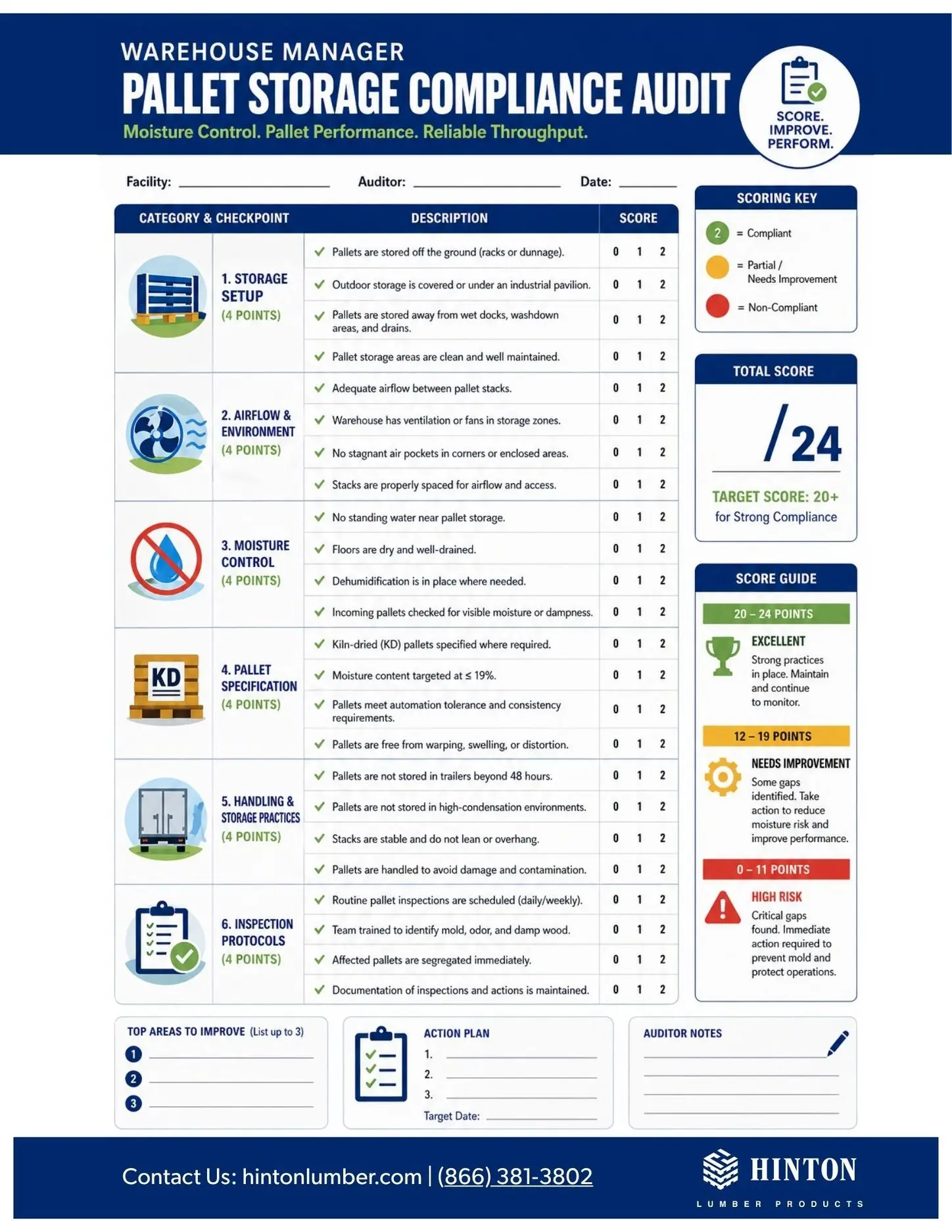
Seasonal Checklist for Warehouse Managers to Prevent Pallet Mold
Before humidity peaks, confirm:
- Pallets stored off the ground
- Adequate airflow between stacks
- Covered outdoor storage
- Avoid extended trailer storage time (>48 hours)
- KD pallets specified where needed
- Inspection protocols in place
Final Thought: Control Moisture, Protect Your Supply Chain
With seasonal changes, pallet storage isn’t just housekeeping; it’s risk management.
The most successful operations don’t just react to mold; they design storage systems that prevent it entirely.
Because at the end of the day: Reliable pallets = reliable throughput
Optimize Your Industrial Pallet Program
Don’t let seasonal moisture compromise your operation.
Hinton Lumber Products delivers engineered solutions for high-throughput, automated environments, built to support consistent performance, reduce mold risk, and keep your supply chain moving. We manufacture from kiln-dried Southern Yellow Pine and design for strength, sustainability, and regulatory compliance. Our Charleston plant supports automation-ready pallets too, optimized for freight efficiency, multi-trip use, and high-volume logistics. Whether you’re managing domestic distribution or global export, the right pallet program makes the difference. Explore our industrial pallets designed for high-performance environments
Ready to improve performance and reliability?
Call our team today to discuss your pallet needs and optimize your operation for every season.
FAQ: Pallet Storage, Moisture & Mold
What causes mold on wood pallets?
Mold forms when wood is exposed to moisture and humidity, especially in warm conditions. Moisture above ~19% significantly increases the risk.
Does heat treatment prevent pallet mold?
No. Heat treatment kills pests but does not prevent mold, as it does not eliminate all moisture.
What is the ideal moisture content for pallets?
Target a moisture content below 19% to significantly reduce mold growth risk.
Can pallets stored indoors still develop mold?
Yes. Indoor environments with poor airflow or high humidity can still lead to mold formation.
How fast can mold grow on pallets?
Under warm and humid conditions, mold can begin to form in 48-72 hours.
Are plastic pallets better for moisture control?
Plastic pallets resist moisture and mold, but wood pallets, especially kiln-dried, remain the industry standard due to cost, repairability, and sustainability.
What is the biggest pallet storage mistake in summer?
Storing pallets in sealed trailers for extended periods or poorly ventilated areas, where condensation builds quickly.
Related Q&A
Question: How is kiln drying different from heat treatment when it comes to mold risk?
Short answer: Heat treatment kills pests but does not remove all moisture, so it does not prevent mold. Kiln drying, by contrast, is specified to reduce wood pallet moisture and helps keep pallets at or below the ~19% moisture content threshold where mold risk rises sharply. In short, moisture, not treatment, drives mold, so choose kiln-dried (KD) pallets when mold control and automation consistency are priorities.
Question: We found early signs of mold on some pallets – what should we do right away?
Short answer: Act fast: separate affected pallets, move them to a dry, well-ventilated area, and increase airflow (fans/ventilation) to accelerate drying. Inspect the surrounding stacks for dampness, dark spots, or musty odor, and keep questionable pallets out of production until dry. Then address the source – avoid sealed trailers, improve drainage, elevate off the floor, and use dehumidification where needed.
Question: What are the most effective ways to improve airflow in pallet storage?
Short answer: Avoid tight stacking, leave space between loads, and use fans or building ventilation to move air through and around stacks. Elevate pallets off concrete floors with racks or dunnage to improve under-stack airflow. Poor airflow is a top driver of pallet mold in warehouses, especially during warm, humid seasons.
Question: If pallets must be staged outdoors or near docks, how can we reduce exposure to moisture?
Short answer: Keep them under cover, off the ground, and away from standing water or poor drainage areas. Designate storage zones away from wet docks, doors, or washdown areas, and maintain spacing for airflow. Do not leave pallets in sealed trailers; temperature swings create fast condensation and sharply increase mold risk.
Question: How does pallet moisture affect automation performance, and how can we mitigate it?
Short answer: Moisture drives dimensional instability and variability, leading to misfeeds, jams, and downtime in high-speed systems. Standardize on automation-ready pallets with consistent specs, preferably kiln-dried pine to help maintain lower moisture levels, and follow seasonal best practices: ensure airflow, keep pallets dry and elevated, avoid closed environments, and inspect frequently.
About The Author: Keith Reinstetle is a National Account Executive at Hinton Lumber Products with over 40 years of experience in the pallet and packaging industry, advising leading manufacturers and retailers on optimizing industrial pallet performance and supply chain efficiency. His expertise in automation-ready pallet solutions and moisture control informs best practices for reliable, high-throughput operations.