
By Craig Stanton – Vice President of Sales, Hinton Lumber Products LLC
In automated grocery and CPG environments, 9-block pallet automation depends on consistent construction and repeatable performance. As automation reshapes warehouse logistics and retail fulfillment, the humble pallet is undergoing a quiet but critical evolution. In high-throughput environments, particularly those in the grocery and consumer packaged goods (CPG) sectors, pallet consistency has emerged as a key driver of operational success.
Increasingly, warehouse-format retailers are standardizing around the 9-block pallet design for its strength, stability, and full four-way access, essential features for automated storage and retrieval systems (AS/RS), robotics, and conveyor-based sorting.
But the shift isn’t just about the specification itself. It’s about producing that pallet with precision, repeatedly and reliably, to meet the demands of automation without introducing downtime or risk.
Automation Systems Don’t Forgive Inconsistencies
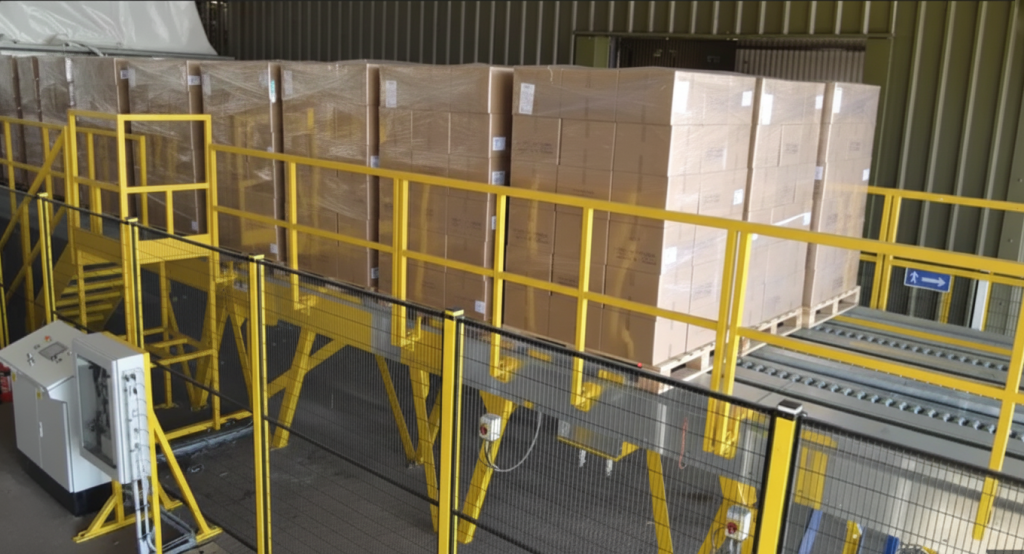
Modern distribution centers are engineered for high efficiency, but with that comes minimal tolerance for error. In a conventional warehouse, a slightly skewed lead board or misplaced block might go unnoticed. In an automated facility, it can halt an entire line.
“You can’t run tomorrow’s logistics on yesterday’s pallets,” notes Larry Howell, President of Hinton Lumber Products, a leading pallet supplier to warehouse-format retailers and manufacturers across the grocery and consumer goods sectors.
This observation is echoed across the industry. According to Food Logistics, automation and safety regulations have led to a new set of expectations for pallet and tote performance, particularly around uniformity. Even small variations in pallet construction can hinder performance or compromise product handling in automated systems.
“When used in automated systems, even slight inconsistencies in pallet construction can hinder performance and impact the entire operation,” the publication reports.
Source: Food Logistics
Consistency Is the New Definition of Quality
Historically, the definition of pallet quality centered on durability, how much weight it could bear or how long it would last. Today, in the age of automation, repeatability has become just as important. A pallet’s dimensions, block placement, and fastening patterns must be identical from one unit to the next.
This evolution aligns with decades of research from the Virginia Tech Center for Unit Load Design. Dr. Marshall White, Professor Emeritus and Founding Director of the Center, has long championed the role of pallet design in achieving supply chain efficiency.
In one study, researchers found that interlocking stacking patterns could reduce pallet deflection by up to 53% compared to column stacking, evidence that even minor adjustments in design and assembly have a measurable impact. Another study showed that the stiffness of unit-load components directly affects pallet deflection and box compression strength, reinforcing the need for consistent, high-quality construction.
According to these studies, optimizing unit load components together, not in isolation, is what unlocks true cost savings and operational efficiency.
Source: Virginia Tech Center for Unit Load Design
Automated Assembly: A Practical Response to Precision Demands
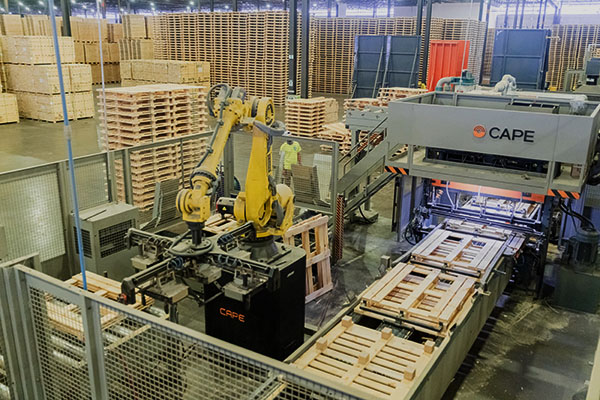
In response to these trends, many pallet manufacturers, including Hinton Lumber Products, have adopted automated assembly systems. These machines ensure that every pallet meets strict dimensional and structural criteria, even at high volumes.
At Hinton, automation enables the company to deliver 9-block pallets that are not only compliant with evolving specifications but also highly uniform, helping reduce the risks of downstream slowdowns or equipment faults. According to Howell, it’s not just about scale, it’s about consistency.
“Automation gives us the ability to produce high volume at exact spec, with no drop-off in precision,” Howell says.
What This Means for Grocery and CPG Supply Chains
For supply chain and packaging professionals, the takeaway is clear: the pallet is no longer a commodity; it’s an engineered interface between your product and the systems that move it. As logistics networks grow more complex and more automated, pallet performance will continue to shape throughput, cost, and product safety.
Understanding evolving pallet specs is important. But being ready to meet them, reliably and at scale. is what truly matters.
Retail Ready, Right Now
As automation accelerates, the most reliable supply chains will be built on components designed and produced for repeatable performance. In highly automated grocery and warehouse-format retail environments, pallet consistency is no longer a “nice-to-have”, it’s foundational to throughput, safety, and system reliability.
“Understanding is good. Readiness is better. We’re both,” Howell says.
For additional background on how 9-block pallet designs support automated handling systems, see our educational overview of block pallet design.