
Exporting to Europe? Then ISPM-15 isn’t enough anymore. The European Union’s new Packaging and Packaging Waste Regulation (PPWR) isn’t just changing packaging requirements; it’s creating a competitive divide between U.S. exporters who adapt and those who don’t.
The real question isn’t whether you can get your pallets into Europe. The question is whether they can stay there profitably.
What Is the PPWR, and Why It Matters
The PPWR, officially published as Regulation (EU) 2025/40, represents a fundamental shift in how transport packaging must function across EU supply chains.
Key changes starting August 12, 2026:
- Transport packaging must support reuse in pooling or return systems
- Packaging must be trackable through its entire lifecycle
- Materials must be recyclable or recoverable at end-of-life
- Full compliance phased in by 2030; mandatory by 2040
While the National Wooden Pallet & Container Association secured important exemptions for U.S. import pallets “under load,” the regulation’s impact extends far beyond the initial entry point.

Downstream Risk: The “Customer’s Customer” Problem
Where repalletization really bites
The port isn’t your biggest challenge. According to industry analysis, the biggest compliance risk isn’t at the port—it’s downstream in your customer’s operations. As Hinton Howell, COO of Hinton Lumber, explains:
“The biggest challenge with PPWR is: does your product need to be repalletized? The National Wooden Pallet and Container Association did a remarkable job of getting U.S. manufacturers excluded from PPWR shipment under load into Europe. The question to be answered is: when the product is delivered to Europe, what happens on the next leg? Is that leg still exempt, or is it not exempt?”
The reality is that European supply chains create multiple trigger points for repalletization:
Where problems occur:
- EU Importers: Must integrate with automated warehouses or pooling systems
- Retailers: Require EPAL pallets for robotic fulfillment
- Warehouses: Demand dimensionally consistent platforms for automation
The Real Cost of Getting It Wrong
Potential Repalletization Costs per Container:
A single compliance slip-up can cost $200–600+ per container.
Typical charges* include:
- Labor and handling: ~$150–300
- New pallet procurement: ~$200–400
- Port delays and storage: ~$75–300/day
- Admin overhead: ~$50–150
*Actual costs may vary significantly based on operational variables, regional
differences, volume agreements, and market conditions.
And that’s not counting the hidden damage:
- Lost trust with EU customers
- Competitive disadvantage vs. compliant suppliers
- Disqualification from automated retail distribution
Why EPAL Pallets Make Compliance Profitable
The solution isn’t just compliance—it’s a competitive advantage.
EPAL pallets don’t just pass compliance checks—they unlock savings, stability, and new markets.
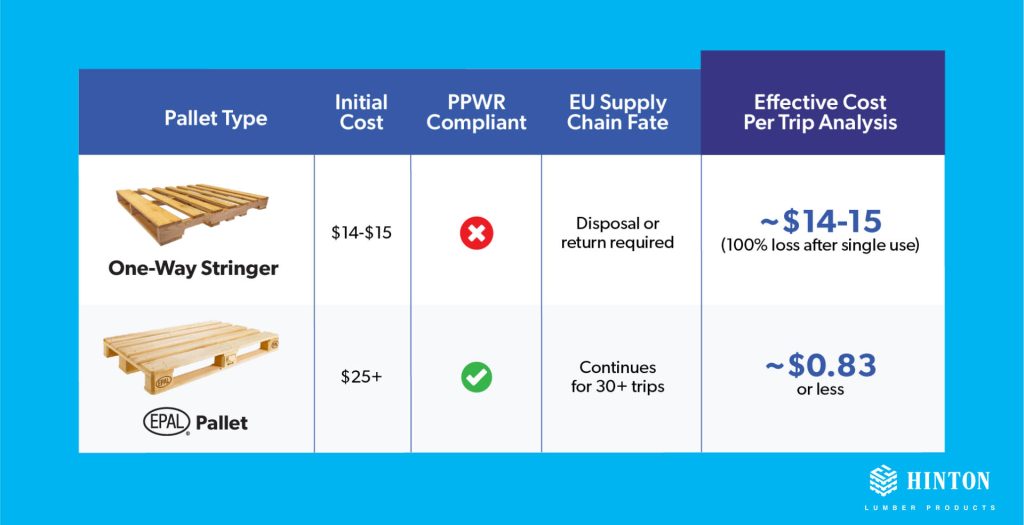
“Some of our clients use the same EPAL pallet for over a decade—30 trips or more. That’s efficiency you can measure in pennies,” Howell explains.
The Automation Imperative: Why Standardization Wins
Compliance is just the beginning. Automation demands standardization, and the EU is moving fast.
- 90% of global pallets are block-style (vs. only 22% in the U.S.)
- European facilities favor uniform, automation-ready formats
- Multinational buyers want consistent platforms globally
“You can automate or you can customize. Not both,” says Howell. “Standard block pallets are the default for any serious EU logistics plan.”
Hinton Lumber: Built to Serve the Global Supply Chain
We were the first to manufacture EPAL pallets in the U.S. at scale—and we’re still leading the way.
What we offer:
- 50,000+ pallets/week capacity
- Full EPAL and FSC certification
- Sourcing across 4 continents
- 25+ years of export market expertise
“We’re not just a pallet supplier. We’re your partner in solving global logistics challenges,” Howell says.
What Should Exporters Do Now?
Four Things You Should Do Before August 2026:
- Map Your Risk: Know which shipments face repalletization risks in EU operations.
- Think Beyond Delivery: Consider second-leg movements and warehouse systems.
- Use Certified Partners: Work with EPAL-certified suppliers who understand EU demands.
- Turn Risk Into Edge: Promote EPAL adoption as both compliance and operational excellence.
The PPWR creates a clear dividing line in the market. You’re either ready or you’re out.
Early adopters will:
- Slash repalletization costs
- Win high-value EU clients
- Meet sustainability and automation standards
Cost-Benefit Assessment Framework: Before switching to EPAL standardized pallets evaluate your specific operational variables including shipping volumes, EU destination types, customer automation requirements, and current supplier agreements. A detailed cost-benefit analysis often makes the business case for you.
Ready to Ship Smarter?
Avoid delays, fees, and EU customer headaches.
Hinton Lumber Products’ EPAL-certified pallets are engineered for the global, circular, automated supply chains that define modern European logistics. Built with sustainably sourced materials and designed for 30+ trip lifecycles, our pallets don’t just meet PPWR requirements—they optimize your total cost of ownership.
Request Your EPAL Spec Today →
Hinton Lumber – Building Pallets for a Global, Circular, Automated Supply Chain
Additional Resources
European Commission: Packaging Waste Guidelines
National Wooden Pallet & Container Association: PPWR Issue Brief
EPAL Standards: European Pallet Association Specifications